

Persian Rug Cleaning in Manhattan: 9 Signs It Needs a Wash
Dull colors, gritty pile, yellow fringe or a smell that will not leave. Here is how to tell when your Persian rug needs a professional wash, the simple tests you can do at home, and how we clean it safely.
Persian rug cleaning
- 20% off your first cleaning
- Plant cleaning with pickup and delivery: $3 per sq ft
- Color test before we start
- Pet stain and odor treatment available
Quick answer: A Persian rug needs a professional wash when the colors look dull or gray, the pile feels gritty, dirt falls out when you shake a corner, the fringe has turned yellow or brown, or there is a smell or pet stain. Weekly vacuuming keeps it healthy between washes. A careful wash every one to three years, sooner in busy rooms, is what keeps the wool and dyes safe for decades.
A good Persian rug can outlive the apartment it lives in. But it only does that if it is washed before dirt and spills start doing damage you cannot see. If you are wondering whether your rug is due, this guide walks you through the signs, the simple tests you can do on your own floor, and what Persian rug cleaning in Manhattan really involves.
We have been cleaning rugs in New York City apartments since 2005. Many of the Persian rugs we see were passed down from parents and grandparents, or bought on a trip many years ago. People love them and are a little afraid of them. They worry that washing will ruin the colors. They also worry that waiting too long will ruin the wool. Both worries are fair, and both have clear answers.
What makes a Persian rug different from other rugs
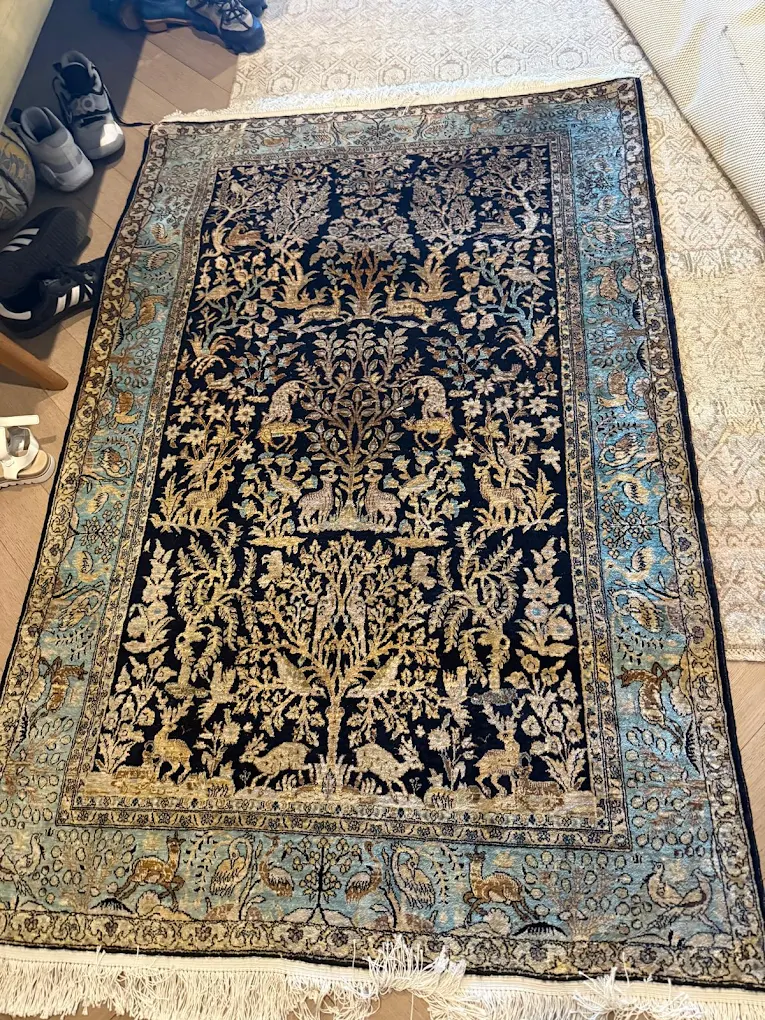
Most Persian rugs are hand-knotted. A weaver ties each knot of wool around the cotton or wool threads of the foundation, row by row. The fringe at each end is not decoration added later. It is the end of those foundation threads. That is why you should never cut it off or pull on it.
The pile is usually wool, and good wool has natural oils that help it shed dirt for a long time. Many older rugs also have dyes that were never meant to meet strong cleaners or hot, soapy water. Some are colorfast and very tough. Others can bleed if they are treated the wrong way.
This is the main reason a Persian rug is not cleaned like wall-to-wall carpet. The fibers, the dyes and the foundation all react differently to water, heat and chemistry. A machine-made rug from a big store can often take a quick, strong cleaning. A hand-knotted Persian rug needs a slower and gentler process, with testing first. If your rug is a different style, our guide to cleaning oriental rugs without damaging them covers the wider family.
Not sure if your rug is hand-knotted? Flip a corner over. On a hand-knotted rug, the back shows the same pattern as the front, a little less sharp, with small uneven knots. A rug with a smooth canvas or glued backing is machine-made or tufted, and it needs a different method.
9 signs your Persian rug needs a professional wash
These are the signs we look for when a customer asks us to take a look. One sign alone may only mean the rug is ready soon. Three or more usually mean it is time.
- The colors look flat or gray. Reds look brownish, ivory looks beige, blues look dusty. Fine dry soil sits around the fibers and dulls the color like a film.
- The pile feels gritty. Run your hand against the pile. If it feels sandy or rough, there is grit deep in the knots, and it acts like sandpaper every time someone walks on it.
- Dirt falls out when you shake a corner. Lift a corner and tap the back. If fine dust drops onto the floor, the vacuum is not reaching it anymore.
- The fringe has turned yellow, gray or brown. Cotton fringe soaks up soil and spills quickly. Dark fringe is often the first sign that the whole rug is holding dirt.
- There is a smell. A musty, sour or pet smell, especially on humid days or when the radiators come on, means something is trapped in the wool or the foundation.
- Pet accidents, even old ones. Urine soaks into the foundation, and wool holds onto it. A spot that looks fine on top can still be doing damage underneath.
- A traffic lane is forming. A darker or flattened path where people walk from the door to the sofa means soil is grinding the fibers down in that line.
- You see moth signs. Bare patches, loose tufts or tiny tunnels along the edges, often under furniture. Moths go for dirty wool in dark, quiet spots.
- It has been more than two or three years. Even if it looks fine, a rug in daily use collects a lot of soil over that time.
None of these signs means your rug is ruined. They mean it is time to wash it before the dirt starts to wear the wool. If your rug has a strong smell after a past cleaning, our guide on why a rug can smell after cleaning explains the usual causes.
Vacuuming, spot cleaning or a full wash?
Not every problem needs a full wash. Here is a simple way to match the problem to the right level of care. These are general patterns from years of cleaning city rugs, not promises, because every rug is different.
| What you see | Vacuum at home | Spot cleaning | Professional wash |
|---|---|---|---|
| Light surface dust | Usually enough | Not needed | Not yet |
| Fresh small spill | Not enough | Blot right away, call if it stays | If the spot spreads or returns |
| Dull, gray colors | Does not help much | Can leave a clean spot that stands out | Best choice |
| Gritty pile, dirt falls out | Removes only the top | Does not reach it | Best choice |
| Yellow or brown fringe | No change | Risk of browning | Best choice |
| Pet urine or smell | No change | Often spreads it | Best choice, often at the plant |
The pattern is simple. Vacuuming protects a clean rug. Spot cleaning helps with a fresh spill. But once dirt has worked its way into the knots and foundation, only a full, careful wash takes it out.
Why Manhattan apartments are hard on Persian rugs
A rug in a Manhattan apartment has a tougher life than a rug in a big suburban house. Small rooms mean the same few paths get walked every day. Street grit, soot and winter salt come in on every pair of shoes, even in buildings with a doorman and a good lobby mat.
Steam heat matters too. In many pre-war buildings, a rug lies a few feet from a radiator that runs hot and dry all winter. Dry heat and dust together make wool feel brittle, and dirt near the radiator often looks darker. In summer, the opposite happens. Humid air can wake up old odors and make a rug smell musty.
Small spaces also mean rugs sit under heavy furniture, beds and desks for years. The parts under furniture stay dark and quiet, which is exactly where moths like to settle. The parts in the open fade in the sun from big windows. Our crews work in apartments from Yorkville and Morningside Heights down to Tribeca, and we see these same patterns in every kind of building.
Tip: Turn your rug around every six months or so. It spreads the wear and the sun more evenly, so one end does not fade or wear faster than the other.
Four simple tests you can do at home
You do not need special tools to check your rug. Try these four tests on a quiet afternoon:
The corner tap test
Fold back a corner so the back faces up. Tap it firmly with your hand for ten seconds, then fold it back and look at the floor. A small line of fine dust is normal. A noticeable pile of grit means the rug is holding a lot of dry soil and needs a wash.
The white cloth test
Dampen a white cloth with cool water, wring it out well, and press it on a light area and a dark area for a few seconds. If the cloth comes up gray, the rug is dirty. If color comes off on the cloth, stop. That dye may bleed, and the rug needs a careful professional wash, not home cleaning.
The light test
Look at the rug from low down, near the floor, with daylight coming from the side. Traffic lanes, flattened pile and dull areas are much easier to see this way than standing up.
The smell test
Get close to the rug on a humid day or right after the heat comes on. A clean wool rug smells like almost nothing. A sour, musty or ammonia smell means something is trapped in it.
Write down what you find. When you call us, these details help us tell you whether an in-home cleaning is enough or whether the rug should come to our plant.
6 mistakes that damage Persian rugs
If you already did one of these, do not worry. Tell us what you used and when. It helps us choose a method that will not react with what is already in the rug. For more of what to avoid, see our list of things never to do to a wool rug.
How we clean a Persian rug
Every Persian rug starts with an inspection, before any water touches it. We look at the fiber, the dyes, the fringe and the condition of the edges and back. Then we test the colors in a hidden spot. This is the step that keeps a good rug safe.
From there, there are two ways to clean it:
- In-home rug cleaning. For rugs in good condition with normal soil, we clean the rug in your apartment. We remove dry soil first, then clean with gentle, wool-safe solutions and controlled rinsing, and we groom the pile so it dries evenly. This works well for rugs that are dull and dusty but not badly stained.
- Plant cleaning with pickup and delivery. For heavily soiled rugs, deep pet urine, smells, loose dyes or fragile areas, we take the rug to our plant. There it can be fully dusted, washed on both sides, rinsed thoroughly and dried flat under control before we bring it back.
We will tell you honestly which one your rug needs. Our oriental rug cleaning and area rug cleaning use the same careful steps for other styles. For very old or fragile pieces, our antique rug cleaning service goes slower and checks the rug at every stage.
Pets and Persian rugs
Pets and Persian rugs can live together, but urine is the biggest risk a wool rug faces. It soaks through the pile into the cotton foundation. As it dries, it can change some dyes and weaken the fibers, and the smell comes back every time the air gets humid.
If your dog or cat has an accident, blot it right away with white towels and a little cool water, and keep the pet off the spot. Do not use ammonia or strong pet sprays from the store on a Persian rug. They can set the stain or move the dye. Our pet stain removal treatment is made for this, and our guide on why pet urine smell comes back explains what happens under the surface.
When a rug has been used by a pet many times, an in-home cleaning is usually not enough. A full wash at the plant is the best way to rinse the urine out of the foundation, not just the top.
Caring for your Persian rug between washes
A professional wash is only part of the story. What you do between washes decides how long the rug stays clean and how long the wool lasts. Keep it simple:
- Vacuum once a week with suction only or the beater bar turned off, and go in the direction of the pile.
- Vacuum the back of the rug a few times a year to loosen deep grit.
- Keep shoes off the rug if you can, especially in winter salt season.
- Use a good rug pad. It stops slipping, protects the back and helps the rug wear more evenly.
- Turn the rug every six months to even out sun and traffic.
- Move furniture a little from time to time and check underneath for moth signs.
- Blot spills right away with white towels. Never rub.
- Keep the rug away from plant pots, radiator leaks and wet boots.
If your rug sits on wood floors, a pad also protects the finish underneath. Our wood floor cleaning can refresh the floor while the rug is out for a plant wash, so both come back clean at the same time.
What Persian rug cleaning costs
We keep the prices simple and tell you the full price before any work starts:
- In-home rug cleaning: $99.
- Plant cleaning with pickup and delivery: $3 per square foot. A 5 by 8 foot rug is 40 square feet, so it comes to $120 before your discount.
- New customers: 20% off your first cleaning. That brings in-home rug cleaning to $79.20 and the 5 by 8 plant wash to $96.
- Silk, antique or very fragile rugs: free quote after we see the rug, price confirmed before we start.
Many customers add a carpet room or a sofa to the same visit. Carpet cleaning is $55 per room and couch cleaning is $99 per sofa. If you have questions about how a visit works, our FAQ page answers the most common ones, and our main rug cleaning service page covers every type of rug we clean.
Where our crews work across Manhattan
Our crews work in every Manhattan neighborhood, from uptown brownstones to downtown lofts. Persian rugs are common in all of them, including:
Near Union Square or the East Village border? Gramercy Park and the blocks around Union Square are part of the 10003 area, and our crews work there every week. See the full list of Manhattan service areas, or learn more about our carpet cleaners in Manhattan on the main page.
Dull colors, dark fringe or a smell? Call us, describe the rug, and we will tell you if it needs an in-home cleaning or a plant wash.
Persian rug cleaning questions
How often should a Persian rug be professionally washed?
In most Manhattan apartments, every one to three years is a good range. A rug in a busy hallway, under a dining table or in a home with pets needs it more often. A rug in a quiet bedroom can wait longer. The signs in this guide matter more than the calendar.
Can you clean my Persian rug in my apartment?
Yes. Many Persian rugs can be cleaned in your home. In-home rug cleaning is $99. Rugs that are very dirty, have deep pet urine, loose dyes or fragile areas do better with a full wash at our plant, with pickup and delivery, at $3 per square foot.
Will washing make the colors run?
Not when it is done the right way. We test the dyes in a hidden spot before any cleaning starts. If a color moves in the test, we change the method or tell you honestly that the rug needs special care before we go further.
Why did my rug fringe turn yellow or brown?
Fringe is the end of the cotton foundation, so it soaks up dirt and liquids fast. Yellow or brown fringe often comes from soil, old spills, harsh cleaners or water that wicked through the rug. Careful washing usually brightens it, but very old staining may not come out fully.
Can I steam clean a Persian rug with a rental machine?
We do not recommend it. Rental machines tend to put too much water into the rug and leave soap behind. On a hand-knotted wool rug that can cause color bleeding, browning, shrinking and a sticky pile that gets dirty faster.
How long does a Persian rug take to dry?
After an in-home cleaning, most rugs feel dry in a few hours with good airflow. Thick rugs take longer. A plant wash includes full drying before we bring the rug back, so it comes home ready to lay down.
Get a rug cleaning quote
Tell us your address and a little about the rug. We will call you back with a price and the first available time.
Prefer to talk? Call (347) 594-1088.
A clean Persian rug can last for generations
$99 in-home rug cleaning · 20% off your first cleaning · Same-day service across Manhattan
