
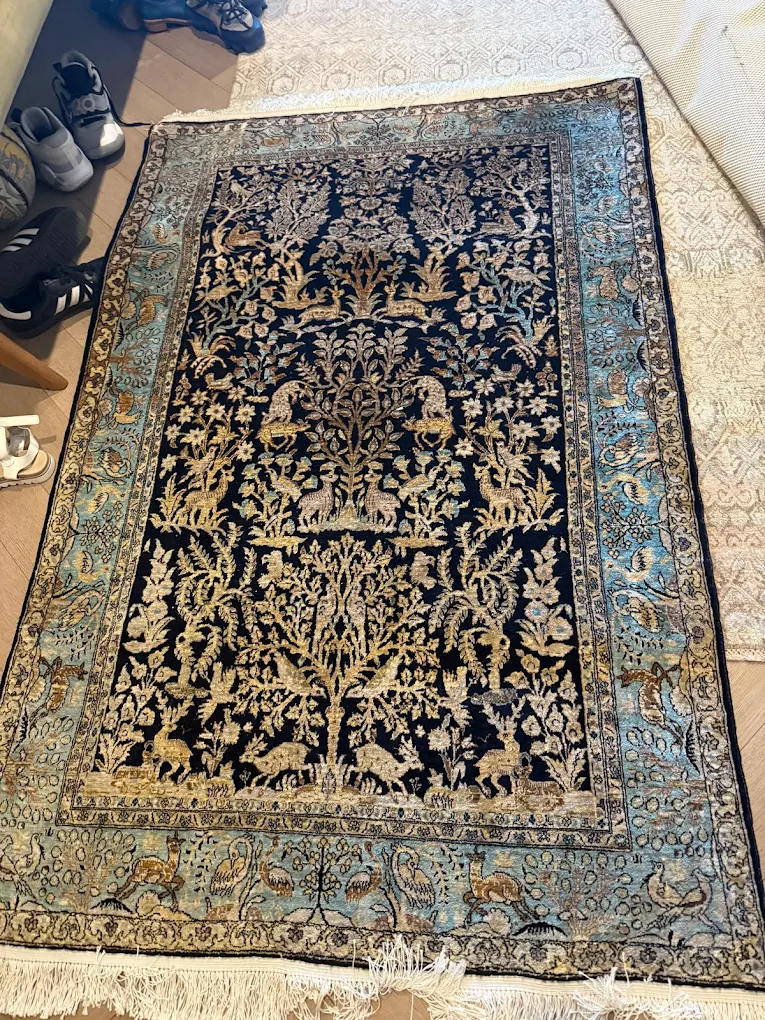
Silk Rug Care in Manhattan: Why Silk Rugs Need Special Care
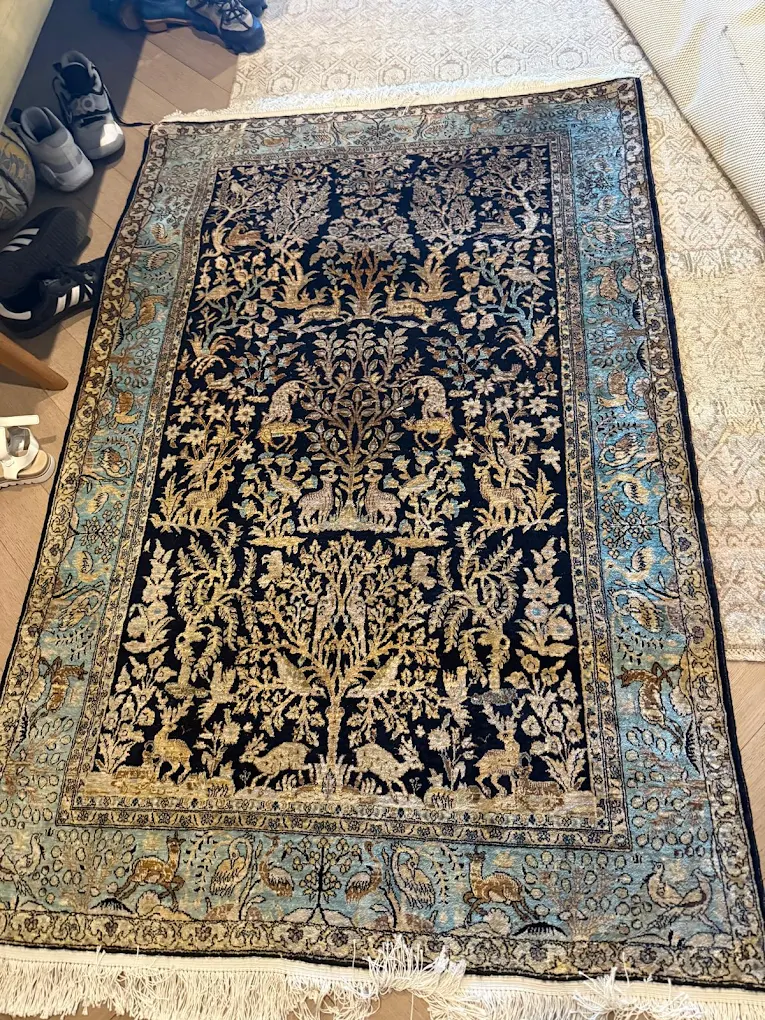
A silk rug is one of the most beautiful things you can put on a floor, and one of the easiest to damage by accident. Here is why silk behaves so differently from wool, how to tell real silk from “art silk,” and how to protect your rug in a busy city apartment.
Silk rug cleaning
- 20% off your first cleaning
- Same-day and next-day appointments
- Dye test before every silk rug
- Pet stain and odor treatment available
Quick answer: Silk is a delicate protein fiber. Strong alkaline cleaners, bleach, too much water, scrubbing and direct sun can all damage it, often for good. Treat a silk rug gently: blot spills with a white towel, never scrub, keep it out of strong sun and away from radiators, and vacuum with suction only. Before any deep cleaning, confirm it is real silk and not viscose “art silk,” because the two react very differently to water. Have it professionally cleaned every one to two years, with a dye test first.
Silk rugs have a shine and softness that no other rug can match. In Manhattan we see them in all kinds of homes: a small prayer-size rug in a bedroom on the Upper East Side, a runner in a pre-war hallway, a fine piece hung near a sunny window on a high floor. Owners usually know the rug is special. What they often do not know is how quickly the wrong cleaning habit can change it. This guide explains what makes silk different and what that means in a city apartment. When the rug needs a real wash, our silk rug cleaning in Manhattan is $4 to $5 per square foot, with 20% off your first cleaning.
We have cleaned rugs, carpets and furniture in New York City homes since 2005. The silk rugs that come to us with the worst problems were rarely neglected. Most were cleaned too hard, too wet or with the wrong product, by someone who was trying to help. A little knowledge prevents almost all of it.
What makes silk different from other rug fibers
Silk, like wool, is a natural protein fiber. That is where the similarity ends in daily life. Silk fibers are very fine and smooth, which is exactly what gives a silk rug its glow. Light bounces off the smooth surface, and the colors change as you walk around the rug. The same smooth, fine fibers also mean the pile has less “body” than wool. It bruises, flattens and shows marks more easily, and it does not hide dirt or damage the way thick wool does.
Silk also reacts strongly to chemistry. A trade article from Cleanfax on the role of pH in cleaning explains that protein fibers such as wool and silk can be destroyed by strong acids and alkalis, and that silk should be cleaned in the close-to-neutral pH range. Most heavy-duty spot sprays and carpet shampoos are made for synthetic carpet and are often alkaline. On silk, that is a risk.
Finally, silk rugs are usually made with very fine knots and often with dyes that are less stable than the dyes in a machine-made rug. When silk gets too wet, those dyes can move, and a crisp pattern can blur at the edges. That is why water is the biggest danger for silk, more than dirt.
What fiber experts say about silk
A silk care fact sheet from Ohio State University Extension, Silk: Special Fabric Needs Special Care, was written for silk fabric, but its basic points about the fiber match what we see on silk rugs every week:
Put together, this explains most silk rug problems we see in Manhattan: faded sides near big windows, dull or rough patches where a strong spray was used, and brown or pale rings where someone poured water on a spill.
Real silk or “art silk”? Why it matters
Not every shiny rug is silk. Many rugs sold as “art silk,” “bamboo silk,” “banana silk” or simply “silk-look” are made of viscose, also called rayon. These rugs can be beautiful and are much less expensive, but the fiber behaves very differently. A Cleanfax article on viscose rayon rugs explains that viscose fibers are weak, that the fiber yellows when it gets wet, and that spills often turn into yellow areas. It also warns that these rugs can turn stiff and matted after cleaning, and that some owners were sold viscose as real silk.
Why does this matter to you? Because the right care for real silk and the right care for viscose are not the same, and the risks are different. Viscose can yellow or harden from a simple glass of water. Real silk is more likely to suffer from dye movement and harsh chemistry. Before any deep cleaning, the fiber needs to be identified.
| What you notice | Real silk | Viscose / “art silk” |
|---|---|---|
| Price when bought | Usually very high, often hand-knotted | Much lower, often machine-made |
| Feel | Fine, smooth, slightly cool | Very soft and slippery, can feel “plasticky” when old |
| After a water spill | Can ring or bleed if dyes are weak | Often yellows, flattens or turns stiff |
| Wear in walking paths | Flattens and dulls slowly | Flattens and mats quickly, can look crushed |
| Cleaning price with us | $4 to $5 per square foot | Free quote, price confirmed before we start |
Tip: Check the label on the back of the rug and look for your purchase receipt. Words like viscose, rayon, art silk or bamboo silk tell you it is not real silk. If there is no label, send us a few clear photos of the front, the back and the fringe, and we will tell you what we think before you book.
8 things never to do to a silk rug
These are the habits that turn a simple cleaning into a repair. Every one of them is common, and every one can leave a mark that does not come out.
Why Manhattan apartments are tough on silk rugs
A silk rug in a quiet country house has an easy life. A silk rug in a New York City apartment deals with a lot more. These are the things we see most often:
- Strong sun from big windows. High-floor apartments, corner units and brownstone parlor floors can get hours of direct light. One end of the rug fades while the other end stays bright.
- Dry radiator heat. Steam heat in pre-war buildings dries the air in winter. A silk rug right next to a radiator can turn dry and brittle on one side.
- Small rooms. In a studio or one-bedroom, there are not many places where nobody walks. The rug often ends up where people pass every day.
- City dust and soot. Fine, oily dust from busy avenues settles into the pile and slowly makes bright colors look gray.
- Street grit and salt. Even if nobody wears shoes on the rug, grit gets carried in on socks and pets’ paws. On silk, that grit dulls the shine.
- Pets in tight spaces. A soft silk rug is a favorite spot for cats and small dogs, and accidents on silk need fast, careful attention.
What to do when something spills on silk
Speed matters, but gentle matters more. Here is what we tell our own customers to do in the first few minutes.
Lift anything solid
Use a spoon or the edge of a card to lift food or mess off the surface. Do not press it down.
Blot with white cotton
Press a clean, white, dry towel on the spot. Do not rub. Move to a dry part of the towel each time, working from the outside in.
Stop if color moves
Look at the towel. If you see any dye from the rug on it, stop right there and call a professional. More water will spread the color.
Use very little water
If there is no color on the towel, mist a tiny amount of cool water on the spot and blot again. Never soak it.
Dry with cool air
Lay a thick dry towel on the spot and press with your hand. Then lift the corner of the rug and point a fan at it. Keep it away from heat.
Watch it as it dries
If a ring, a brown edge or a yellow patch appears as it dries, do not try again. Call us. More home treatment usually makes it worse.
For coffee and tea, our guide to removing coffee stains from area rugs has more detail, but on silk, use the gentlest steps only. If a smell stays after a spill or an accident, read why a rug can smell after cleaning, because the cause is usually moisture deep in the foundation.
Where to put a silk rug in a small apartment
In a Manhattan apartment, where you put a silk rug matters as much as how you clean it. A few simple choices protect it for years:
- Low-traffic rooms: a bedroom, a home office or under a coffee table where people sit, not walk.
- Away from the front door: keep it out of the entry and the path to the kitchen, where grit and spills happen.
- Out of direct sun: use sheer curtains or UV film on very sunny windows, or move the rug out of the brightest spot.
- Away from radiators: leave a gap between the rug and the radiator, so one edge is not baked all winter.
- On a good rug pad: a pad keeps a small rug from sliding on wood floors and reduces wear on the back.
- Not under dining chairs: chair legs grind food and grit into the pile and pull at the knots.
Tip: Turn your silk rug 180 degrees every six months. In a small room with one big window, this simple habit spreads out sun and traffic, so the colors fade evenly instead of on one side.
An easy silk rug routine
Good silk care is quiet and simple. You do not need special products. You need a light touch and a regular schedule.
- Weekly: vacuum lightly with suction only, or use a soft brush attachment. Move in the direction of the pile, which you can find by running your hand along the rug. It feels smooth one way and rough the other way.
- Monthly: vacuum the floor under the rug and lightly vacuum the back. Grit that falls through still wears the rug.
- Every season: check edges and corners, under furniture and along the wall, for loose tufts, bare spots or signs of insects.
- Twice a year: rotate the rug 180 degrees.
- Fringe care: do not vacuum over the fringe. Flip the edge of the rug over and vacuum the back instead, or comb the fringe gently by hand.
- Every one to two years: book a professional cleaning, or sooner for pets, spills or a rug in a busier room.
If you also own wool rugs, they need a slightly different routine. Our guide to wool rug care in Manhattan covers that, and our wool rug cleaning page explains how we handle them.
Signs your silk rug needs a professional cleaning
Silk rarely looks “dirty” the way a light wool carpet does. Instead, it loses its life. Watch for these signs:
- The shine is gone and the colors look flat or gray, even after vacuuming.
- Parts of the pile look crushed or matted, especially where people walk.
- There is a ring, a brown edge or a yellow patch from an old spill.
- The rug smells musty, like pets or like cooking.
- You are moving, renovating or putting the rug into storage.
- A pet had an accident on it, even if you cleaned it right away.
Many silk rugs are also Oriental or Persian designs, and some are old. Our Oriental rug cleaning, Persian rug cleaning and antique rug cleaning pages explain how we handle fine and older pieces. For gentle home care on hand-knotted rugs in general, see how to clean Oriental rugs without damaging them.
How we clean silk rugs
With silk, the most important work happens before any cleaning starts. Here is what happens when you book us for a silk rug:
- Fiber check. We look at the front, the back, the fringe and any labels to confirm whether the rug is real silk, viscose or a blend. If it is not real silk, we tell you before we go further.
- Condition report. We point out wear, sun fading, old repairs, rings and stains that may not fully come out, so you know what to expect.
- Dye test. We test the colors in small spots. If the dyes are not stable, we change the plan or tell you honestly that the rug should not be wet-cleaned.
- Dry soil removal. We remove as much loose dust and grit as possible first, gently, so it does not turn to mud during cleaning.
- Gentle pre-treatment. Spots get products suited to silk, close to neutral pH, never harsh shampoo or bleach.
- Careful rinse and extraction. We use hot water extraction with controlled moisture and strong suction, so the rug is rinsed without being soaked.
- Grooming and drying. We groom the pile in its natural direction and set up airflow for fast, cool drying. We tell you when it is safe to walk on it and put furniture back.
You will always hear the honest version before we start. Some sun fading, old rings and worn areas cannot be reversed, and we would rather tell you that than promise something we cannot deliver.
What silk rug cleaning costs in Manhattan
Silk rug cleaning is priced by size: $4 to $5 per square foot, and new customers get 20% off their first cleaning. Silk rugs are often smaller than wool rugs, so here are some common sizes:
| Rug size | Square feet | Price range | With 20% off first cleaning |
|---|---|---|---|
| 2 × 3 ft | 6 | $24 – $30 | $19.20 – $24 |
| 3 × 5 ft | 15 | $60 – $75 | $48 – $60 |
| 4 × 6 ft | 24 | $96 – $120 | $76.80 – $96 |
| 5 × 7 ft | 35 | $140 – $175 | $112 – $140 |
| 6 × 9 ft | 54 | $216 – $270 | $172.80 – $216 |
The exact price depends on the rug and its condition, and we always confirm it before we begin. Viscose and other “art silk” rugs are a free quote, with the price confirmed before we start. For everyday rugs in the rest of your home, see our rug cleaning service. Questions about scheduling, drying time or payment are answered on our FAQ page.
Silk rug cleaning across Manhattan
Our crews work in every Manhattan neighborhood, from walk-ups to doorman buildings, co-ops and condos. Find rug cleaning in your area:
Don’t see your neighborhood? View all of our service areas in Manhattan, or learn more about Manhattan carpet cleaning for your wall-to-wall carpet, upholstery and mattresses.
Is your silk rug losing its shine? Book a gentle, careful wash with a dye test first.
Silk rug care questions
Can I clean a silk rug myself?
You can vacuum it gently with suction only and blot fresh spills with a white towel. Deep cleaning at home is risky, because too much water or the wrong product can move the dyes, leave rings or make the fibers rough.
How do I know if my rug is real silk or art silk?
Check the label and your receipt. Words like viscose, rayon, art silk or bamboo silk mean it is not real silk. If there is no label, send us clear photos of the front, back and fringe and we will tell you what we think.
Why did my silk rug turn yellow after a spill?
Yellow or brown patches after a water spill are very common on viscose rugs that look like silk, because viscose yellows when it gets wet. On real silk, a spill can also leave a ring. Do not keep treating it. Call a professional.
Can I use carpet shampoo or a spot spray on silk?
Most carpet shampoos and all-purpose sprays are too strong for silk. Silk should be cleaned close to neutral pH. Never use bleach or oxygen powders on a silk rug.
How often should a silk rug be professionally cleaned?
Every one to two years in most Manhattan homes. Rugs in busier rooms, homes with pets, or rugs with a spill or odor may need cleaning sooner.
How much does silk rug cleaning cost in Manhattan?
$4 to $5 per square foot, with 20% off your first cleaning. A 4 by 6 foot rug is 24 square feet, so it costs $96 to $120, or $76.80 to $96 with the first-cleaning discount. Viscose rugs are a free quote, with the price confirmed before we start.
Get a free silk rug quote
Tell us the size of your rug and your address. We will call you back with a price and the first available time.
Prefer to talk? Call (347) 594-1088.
Keep your silk rug shining for years
$4–$5 per sq ft · 20% off your first cleaning · Same-day service across Manhattan
