
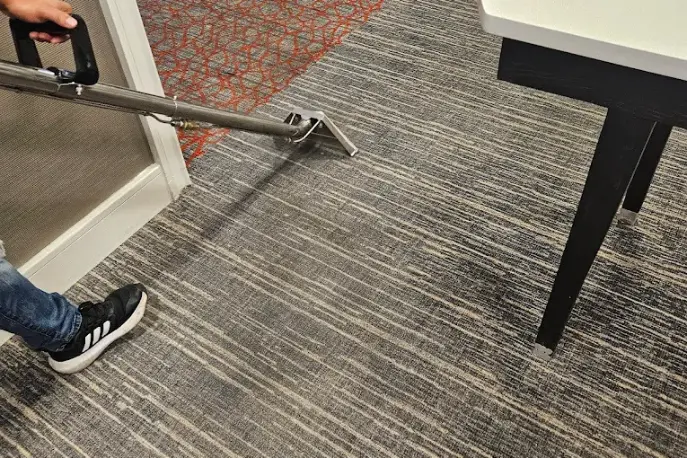
Winter Salt Stains on Carpet: How to Fix Them in a Manhattan Apartment
Every snowstorm, Manhattan sidewalks get covered in salt and ice melt, and a lot of it ends up on the carpet inside your door. Here is what those white lines and dark rings really are, what you can safely do at home, and when a professional rinse is the better choice.
Salt stain carpet cleaning
- 20% off your first cleaning
- Same-day and next-day appointments
- Salt and ice melt treatment included
- Pet stain and odor treatment available
Quick answer: Those white lines and dark rings near your door are salt and ice melt from the sidewalk. Vacuum the dry grit first, then blot the marks with plain warm water and a white towel, and do not scrub or pour on soap. Salt keeps working its way deeper every time the carpet gets wet, so a professional hot water rinse at the end of winter is the surest way to get it all out.
If you live in Manhattan, you know the look: a crusty white line on the carpet just inside the front door, a gray ring where wet boots stood, a path of dull, stiff fibers leading to the kitchen. This guide explains what is really in those marks, what you can safely do at home, and when it makes sense to call for professional carpet stain removal in Manhattan.
We have cleaned carpets in New York City apartments since 2005, and every winter the calls change. In the fall it is coffee, wine and pets. From December to March it is salt. The good news is that most salt stains come out well. The bad news is that the longer they stay, the harder they get.
What winter salt actually does to your carpet
When snow falls, the city, building supers and store owners spread salt and ice melt on almost every sidewalk and corner. That slush sticks to your boots, your stroller wheels and your dog’s paws. A few steps later, it is in your carpet.
Once inside, three things happen:
- The water dries, the salt stays. Salt dissolves in the slush, soaks into the fibers, and is left behind as a white crust when the water evaporates. That is the chalky line you see by the door.
- It grabs dirt. Salt residue makes fibers rough and a little sticky, so street soil clings to them. White marks slowly turn gray and then brown.
- It moves around. Each time new slush lands on the same spot, the old salt dissolves again and spreads wider and deeper, toward the backing and the pad.
Facility managers deal with this on a big scale in office lobbies. An industry article on choosing deicers for buildings with carpet notes that chloride deicers can leave a white residue that fades carpet color, and that some leave an oily film that harms floor finishes. In a small apartment the effect is the same, just concentrated in the first few feet inside your door.
Tip: Salt damage is about time, not just amount. A light white mark cleaned in a week is easy. The same mark left until April, re-wet twenty times, is a much bigger job.
Rock salt vs. ice melt: not all white marks are the same
Not every winter product behaves the same way on carpet. Here is a simple way to tell what you are dealing with:
| Rock salt (plain salt) | Ice melt blends (often calcium or magnesium chloride) | |
|---|---|---|
| What it looks like on carpet | Dry, white, chalky crust, sometimes with grit | Darker ring, oily or greasy feel, sometimes a white edge |
| How it feels | Crunchy and stiff | Damp, tacky or slippery even when the room is dry |
| Where you see it | Entry mats, hallway runners, near the radiator where boots dry | Lobby-to-door paths, under boot trays, stroller parking spots |
| Home blotting with warm water | Often helps a lot | Helps a little, but the film usually stays |
| Professional treatment | Hot water rinse removes most of it | Needs a careful rinse with the right chemistry, not just soap |
The second column is the tricky one. Cleaning companies have learned that ice melt containing calcium chloride can react badly with ordinary cleaning soaps. One cleaning industry tech note on ice melt residue explains that common soapy pre-sprays can bind with calcium chloride and leave a gummy mess on the fibers. That is why scrubbing with carpet shampoo often makes these spots look worse a week later.
Why Manhattan apartments get hit harder
Salt is a problem anywhere it snows, but Manhattan living adds a few twists we see every winter:
- Everybody walks. You do not step from a garage into a mudroom. You walk blocks of salted sidewalk, cross slushy corners and come straight into a small apartment where the front door opens onto carpet.
- Sidewalks get salted fast and often. City rules give property owners only a few hours to clear snow after it stops. According to NBC New York, citing the Sanitation Department, if snow stops between 7 a.m. and 4:49 p.m., the sidewalk must be cleared within four hours. That means heavy salting all over the city right after every storm.
- Long walk from the lobby. In doorman buildings the salt rides through the lobby, into the elevator and down the hallway carpet before it ever reaches your door.
- Walk-ups. In older walk-ups, the stairs and landings collect slush from every tenant, and a lot of it ends up on the runner outside your apartment and the first rug inside.
- Radiators. Many people dry wet boots near a radiator. The heat dries the slush quickly, so the salt crust forms right there on the rug or carpet next to it.
- Small spaces. In a studio, the entry, living room and kitchen path are the same few square feet, so salt from every trip lands in the same place.
How to read a salt stain
Before you treat anything, take a minute to look closely and touch the spot. What you see tells you how deep the problem goes.
White, dry crust on top
Fresh salt that has not soaked in yet. Usually the easiest to fix. Vacuum and blot.
Wavy white tide lines
Slush dried in rings. The salt is now inside the fibers, but often still above the backing.
Gray or brown ring
Salt has been grabbing street dirt for a while. Needs a full rinse, not just water and a towel.
Sticky or greasy patch
Often ice melt film or soap residue from an earlier attempt. Home cleaning tends to spread it.
Stiff, rough fibers that will not stand up
Salt has dried deep in the pile. The carpet may feel crunchy underfoot.
Marks that come back on rainy days
Salt is still in the backing or pad and moves up again when the air is humid or the carpet gets damp.
If you see the last three, home treatment will only go so far. The salt is below where a towel can reach.
First steps at home: what actually helps
For fresh marks, a few minutes of the right care can save a lot of trouble. Here is the method we tell our own customers:
- Let it dry first. Wet slush spreads when you rub it. If the spot is still wet, blot up what you can and let it dry.
- Vacuum slowly. Go over the dry spot several times in different directions to lift loose salt crystals and grit. A crevice tool helps along the edge of the door.
- Blot with plain warm water. Dampen a clean white towel with warm water, press it on the stain, and lift. Do not soak the carpet. You want to dissolve the salt into the towel, not push it down.
- Rinse the towel often. Turn to a clean section or rinse it in the sink after every few presses. A dirty towel just moves salt around.
- Dry blot. Finish with a dry towel and press firmly, standing on it if you like, to pull up the last moisture.
- Let it air dry and look again. Salt marks often look gone when wet and come back as they dry. If a faint ring returns, repeat once. If it comes back again, stop there.
Honest advice: If two rounds of warm water do not fix it, more rounds usually will not either. Every extra soaking pushes salt toward the pad. That is the point to stop and let a professional rinse do the rest.
6 salt-stain mistakes we see every winter
Nearly all of these come from good intentions. People want the stain gone today, so they reach for the strongest product under the sink. With salt, gentle and patient works much better than strong and fast.
Stop salt at the door
You cannot stop the city from salting sidewalks, but you can stop most of it from reaching your carpet. A few habits make a big difference in a small apartment:
- Put a rough, absorbent mat outside the door if your building allows it, and a washable one inside
- Add a boot tray right by the door so wet shoes never sit on carpet
- Make the apartment shoes-off from December to March and keep slippers by the door
- Wipe your dog’s paws with a damp cloth after every walk, especially between the pads
- Wipe stroller and cart wheels before they roll across the living room
- Shake out or wash the door mat every week, not just when it looks dirty
- Vacuum the entry area every few days in winter, even if it looks clean
- Move a light-colored or valuable rug away from the door until spring
For more ideas on protecting floors through every season, read our guide on how NYC weather affects your carpets.
How we clean salt out of a Manhattan carpet
Getting salt out is mostly about rinsing, not scrubbing. Here is what happens when our technician comes to your apartment:
- Look and test. We check the stains, feel the fibers and ask what was used on them before. Earlier soap or spot cleaner changes how we treat the area.
- Dry soil removal. A thorough vacuum pulls out salt crystals and grit first. Wet cleaning with grit still in the pile just makes mud.
- Pre-treatment. Salt and ice melt areas get a pre-spray chosen for mineral residue, and we keep soap low so nothing turns gummy.
- Hot water extraction. Our steam carpet cleaning flushes the fibers with very hot water and pulls the dissolved salt back out with strong suction. That is the step a towel at home cannot do.
- Second pass where needed. Entry areas and boot spots often get an extra rinse so salt does not wick back up as the carpet dries.
- Grooming and drying. We brush the pile so it stands up evenly and set up air movement. In winter, radiator heat helps rooms dry fast.

If you ever had carpets cleaned and they looked dirty again a few days later, salt and leftover soap are common reasons. We explain more in why carpets can still look dirty after cleaning.
For whole apartments, our residential carpet cleaning covers every carpeted room, and the winter entry area gets extra attention as part of the job.
Area rugs, entry runners and hallway carpet
Area rugs by the door take the worst of winter. They are often the first thing wet boots touch, and many are wool, which holds onto moisture longer than synthetic carpet.
- Wool rugs: Wool is strong, but salt left in it can make the fibers feel harsh and dull. Blot with plain water only and avoid heat. Read our wool rug care guide for more do’s and don’ts.
- Synthetic runners: These are usually the easiest to clean, but they show tide lines clearly. Regular vacuuming in winter helps a lot.
- Fine or valuable rugs: Move them away from the entry for the winter. It is much easier than fixing salt damage later.
- Building hallway carpet: This belongs to the building. If the hallway is full of salt, it ends up in your apartment too, so it is worth asking management when it will be cleaned.
Our area rug cleaning service handles everyday wool and synthetic rugs, and we can clean them together with your wall-to-wall carpet in one visit.
Tip: Roll the entry rug away for a day after a big storm, when the sidewalks are at their saltiest. Put down a cheap washable mat instead, then bring the rug back once the slush is gone.
What salt stain cleaning costs
Salt treatment is part of our regular carpet cleaning, not an expensive extra. The price is simple: $55 per room, and new customers get 20% off their first cleaning.
| Apartment | Carpeted rooms | With 20% off first cleaning |
|---|---|---|
| Studio | 1 room – $55 | $44 |
| One bedroom | 2 rooms – $110 | $88 |
| Two bedroom | 3 rooms – $165 | $132 |
| Three bedroom | 4 rooms – $220 | $176 |
Wool and silk rugs are $4 to $5 per square foot. Other area rugs, stairs and hallway runners get a free quote, and we always confirm the price before we start. If guests are coming this weekend or the building needs the apartment ready for a showing, our same-day carpet cleaning can often fit you in.
Where our crews work in Manhattan
Our crews work across Manhattan all winter, from brownstones and walk-ups to doorman towers and co-ops. A few neighborhoods where salt stains keep us busy:
See every neighborhood on our Manhattan service areas page, or find answers to common questions on our carpet cleaning FAQ. To learn more about who we are, visit our home page for Manhattan carpet cleaners who have worked in city apartments since 2005.
Salt lines by the door? Book now and get your carpets fresh before the next storm.
Winter salt stain questions
Will winter salt stains come out of my carpet?
Most do. Fresh white salt marks usually come out fully with a proper hot water rinse. Older stains that turned dark or sticky take more work, and a few spots on light carpet can leave a faint shadow, but they nearly always look much better.
Can I just vacuum the white salt marks?
Vacuuming lifts the loose grit on top, which is a good first step. It does not remove the salt that has dried inside the fibers, so the white haze comes back once the carpet gets damp again.
Should I use soap or carpet shampoo on salt stains?
Go easy on soap. Ice melt that contains calcium chloride can react with ordinary soapy cleaners and turn into a gummy, sticky film. Blot with plain warm water first, and leave the deeper cleaning to a rinse that pulls everything back out.
When is the best time to clean salt out of carpets?
Do quick blotting at home all winter, then book a full cleaning once the worst of the snow is over, usually late February or March. If the stains are heavy or you are moving out, clean sooner.
Do you clean area rugs with salt damage too?
Yes. We clean wool, synthetic and other area rugs that took a beating in the entry. Wool and silk rugs are $4 to $5 per square foot. Other area rugs get a free quote, and we confirm the price before we start.
How much does it cost to clean salt stains out of carpet?
Carpet cleaning is $55 per room, and stain treatment for salt is part of the job. New customers get 20% off their first cleaning, so one room comes to $44.
Get a free quote
Tell us your address and how many rooms. We will call you back with a price and the first available time.
Prefer to talk? Call (347) 594-1088.
Get the winter salt out of your carpets
$55 per room · 20% off your first cleaning · Same-day service across Manhattan
